
One thing that often comes to mind when viewing beginners’ landscape photographs is that they chose the wrong time to take the picture. It takes a while to learn what difference light makes and depending on the subject, there is a number of other factors playing in. Say for example, if you want to show how beautiful a lake is, you don’t shoot it in cloudy and windy weather when waves break the surface and everything is dull grey. Well, I wouldn’t, anyway. If you have your subjects within easy reach, the problem is also easily solved – you just wait until the conditions are right and then take a picture. However, when you are on a holiday and you only have a small window when to photograph, it gets tricky – you rarely get the images you wanted to take and instead have to work around the obstacles (bland skies, wind, dull light etc). Sometimes you just simply have to give up because the image just isn’t there for the taking right then.The next question is, is it only the conditions that can prevent a beautiful image to be created? My theory is that a good photographer can take a good image of anything given some time to wait for the right circumstances. But there is one subject I have come across that has seriously challenged that. It is entirely possible that there are places where you’ll never be able to take a kick-ass image, quite irrespective of the weather conditions. One such place is Njupeskär, the highest waterfall in Sweden. As the highest one in the country, I would somehow expect Njupeskär to be magnificent enough to make a good image. Of course nature doesn’t have any respect for my photographic aspirations, all I’m saying is that if you just think about the waterfall and nothing else around it, it is a great one and definitely a worthy subject. But in the real world you can’t isolate the waterfall from its location and this is where the photographic problems begin.
Let’s look at the geography. The falls formed as the water carved its way through rock and now the waterfall is situated at the end of a narrow ravine. So unless the sun shines directly into the ravine, the contrast the light and shadows create is extreme. But you rarely get sunshine in the ravine, because it’s facing north. I made an estimate that there would be sunlight on the falls very early in the morning during midsummer, when the sun shines from a slightly northerly direction. The theory was confirmed correct when I found a web page that included an image taken during this rare event – apparently, the sun shines at the falls 2 hours after sunrise during two weeks around midsummer and the light lasts for about half an hour. There’s your window…! But would this sunlight make the kick-ass image I’m after? There are other things to consider. With the sun at your back and the waterfall and the ravine’s edge above you, there is no way you can avoid including sky in your image if you want to photograph the entire falls. Unfortunately, the sky opposite a sunrise during midsummer isn’t very flattering, so you’d have to contend with a washed out blue sky above your blazing falls. Not kicking ass I’m afraid.
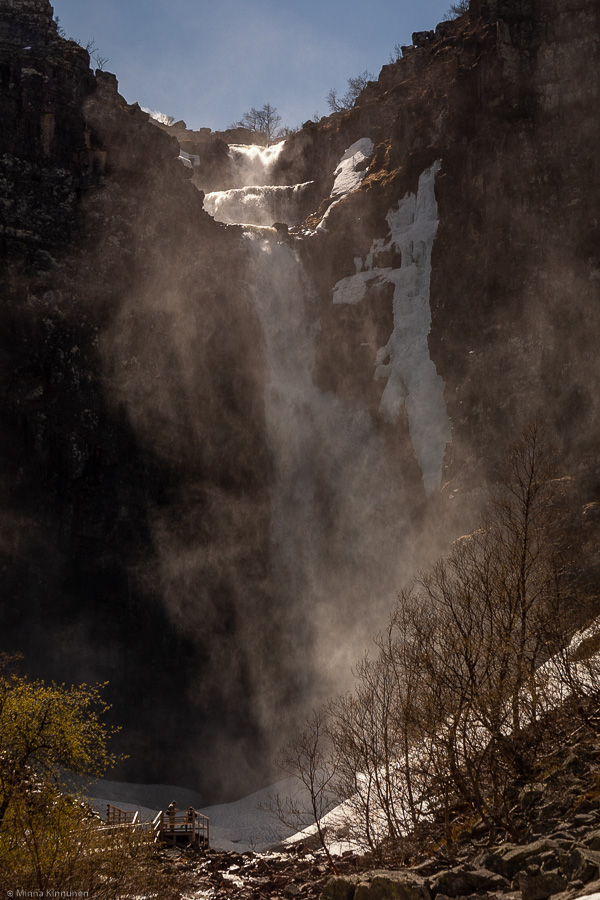
On the left you can see the an image from the first time I was at Njupeskär. It was noon and I got a proper blue sky on top, but the top of the falls is blown out while the rest of the water and the ravine walls are in deep shade. In order to come over this, you can zoom in tighter and eliminate the highlights – it’s just that you’ll end up eliminating much of the falls themselves, as well. But I want the whole waterfall, because the height is the point here!
So forget about sunlight. I like waterfalls during overcast conditions anyway, this eliminates those pesky contrast problems. However, if the washed out blue sky is a downer, a blown out white cloud cover is a definite turn-off. So we’re back at leaving things out from our composition and that’s exactly what we don’t want here.
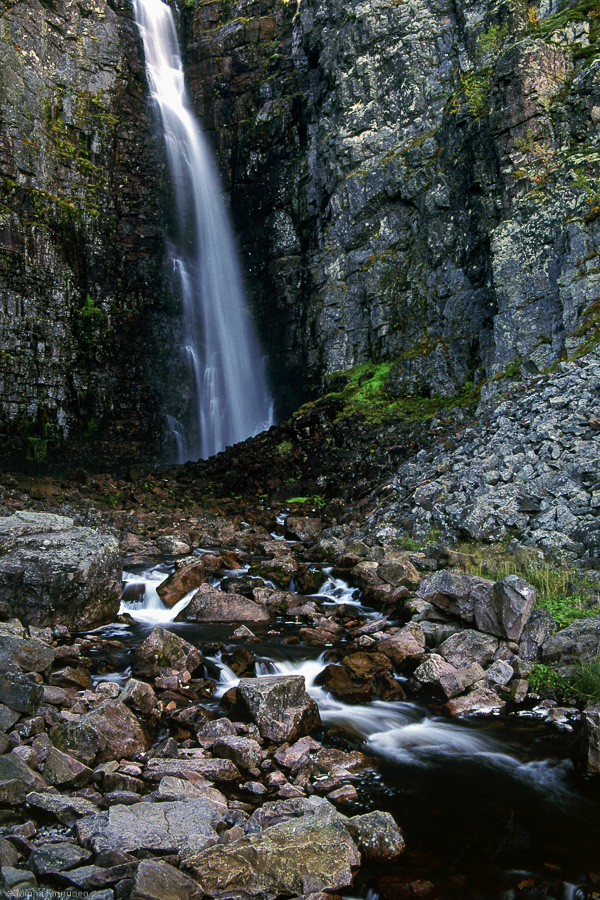
When you use a wide angle lens for a landscape, you need to build up the image carefully. You need a foreground – the water can’t fall out of the edge of your image, so to speak. On the right you can see an image from the second time I was at the falls. It looks a bit dark but it’s owing to a poor scan… I’m just presenting it for the cropped view and the foreground. But, this image is taken from the platform. There are probably thousands of photo albums that include a very similar image. Been there, seen it, done that… now I want something special, a viewpoint that not everyone has seen.
If you want a natural image without the hand of man like I do, then you have to work around the wooden platform that crosses the creek and then follows it up to the foot of the falls (you can see it in the first image above). Let’s not forget that we’re in a National Park where it’s forbidden to step outside the marked trail… but since we are theoretically chasing a theoretical kick-ass image, we can theoretically locate ourselves anywhere in the ravine!
So let’s cross over the creek then and photograph opposite to the platform so that the creek can be used for the foreground. You’ll find yourself balancing on the sharp and slippery rocks while trying to find a viewpoint where the creek makes a sufficiently interesting foreground and the wooden platform is hidden. Good luck.
And this is where I am right now… I think I have covered just about all the problems Njupeskär presents to an ambitious photographer, so it’s time I get back to my original question. Is there a kick-ass image waiting at Njupeskär, or is it time to face the facts and settle for less?

Personally, I’m leaning towards the mediocre. I don’t have many kick-ass pictures in my album to start with, so I don’t stand much of a chance with a challenging subject like Njupeskär. My best offer so far is on the left, where the fog was the solution to the open space on top – although you still have a vast white expanse, it fades out nicely instead of contrasting with the edge of the ravine. But my foreground is too close to the camera and the wide angle distorts the size, and the big waterfall is almost hidden behind the tree which in its turn hides the platform.
I reckon I’ll visit Njupeskär some early morning during midsummer and then give up!
During my latest trip to Njupeskär I was in the company of other photogs. One of them succeeded in finding a new angle and the resulting image was the best I have seen so far – and I reckon, among the best there are to be had, period! One question remains – what can I do?
Lämna ett svar