
Imagine a sparse pine forest. Imagine the forest floor as it typically is in these forests – covered with lichens and mosses and heather and blueberry/cowberry/crowberry brush and juniper bushes. Now imagine the leaves of a pale pasque flower. And imagine that there is just one pale pasque flower individual in all of this forest.
What would you imagine are the odds at finding this one individual?
Not very high I would say, but I found it!
I only know of two locations with the pale pasque flower, the favourite being Gröntjärn. Since I moved to Loos however, Gröntjärn is very far away so I was wondering if it grows anywhere closer to Loos. I spoke with my flower guide and sure enough, there is a location north from Rullbo. He was there in the mid-90’s and found hundreds of plants, out of which about 250 produced blooms.
Problem is that 15 years is a long time in nature. Trees grow and forests are cut down, so finding the exact same spot you visited many many years ago is not all that easy. Last week we tried but found nothing. We concluded that it’s too early anyway so now we tried again. It turned out that one week is also too long to remember the exact same spot… because we drove past the place we searched last week! But this time my guide had found the old notes he had written down back then, and he said that the flowers were growing among juniper bushes. The place we searched last week had no juniper at all, so now that we were trying to remember where we had parked last week we were also looking into the forest to see any areas with juniper. And we found it, so searching for the pale pasque flower became a bit easier because now we were confident that we were in the right place. But it’s still a lot of area to cover. Until suddenly, there they were… pale pasque flower leaves!
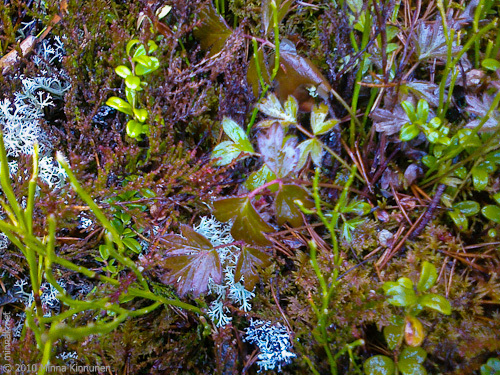
I figured that searching for plants is a combination of skill and luck. You need luck to happen to walk past just the right spot, and skill to understand what you see. I’m starting to think that maybe I’ve learned something during all these excursions I’ve made with my flower guide. Learning to photograph is learning to see. And learning to find flowers is also about developing a vision that is tuned in to the plants. Very often it comes down to looking at the green pattern in front of you and seeing the deviation in that pattern.
I mentioned that back when my guide had last visited the place, there were hundreds of individuals. And now we only found one (normally when you find one, it’s much easier to find more because you know exactly what you’re looking for). But my guide had noted down one more interesting detail – the time. He had been there close to midsummer, and still found some individuals in bloom. This is very late, compared to Gröntjärn where I’ve always seen them during the first half of May. But it’s also a different climate. There are places around Loos which almost remind of an alpine environment, so it’s hardly surprising that we have some plants here you normally see in the mountains. With this in mind, we concluded that it’s just way too early for them at the moment, so we will come back in two weeks in hopes of finding more individuals. Because this is a the right place, we are 100% sure about that. We just need to find it again…
This is a fairly typical situation for us when we’re searching for flowers. My guide has a memory (sometimes good, sometimes vague – it can be decades since he’s last visited some of these places) of the location and then we just walk up and down the area until we find what we’re looking for. Most of the time when we don’t find it, it’s because the timing is off so we come back a week or two later and there it is. So far we’ve actually found everything we’ve looked for which is a pretty good record!
Lämna ett svar