
I was in a hurry to get some sleep last night so I will write down the full experience now. I’m new at aurora photography (and night photography in general) so I have to take some notes to learn.
But before I get to the nuts and bolts of the event, I just have to say this – it was awesome! It was just me, my camera, the northern lights and an owl howling in the neighbourhood. Well worth the sleep deprivation!
1. Composition
I used a hot shoe bubble level to level the camera and pointed it in the general direction of the northern lights. Take a picture, check the LCD and then adjust camera position, repeat process until the desired composition is reached. It worked out so well that I didn’t even need to crop the pictures in post-processing.
How in the world they did this with film I’ll never know!
I wasn’t spoiled with foreground options. We have forest everywhere (even if de-forestation is one my favourite complaints) so there aren’t many open views within a walking distance, especially those towards north and without light pollution. I was standing on a forest clearing with these lonely trees scattered around, so it was just a matter of picking out the most suitable tree to provide a silhouette against the lights. Considering how dark the pictures are, it’s safe to say that the aurora alone wouldn’t lift the photo. Even so, it’s a close call – there’s an awful lot of ”dark matter” in the frame.
I’m also glad that the Sigma 15mm f2.8 fisheye is earning its keep now. It seemed like a good idea at the time, but I found very little use for it last summer – I just can’t handle wideangles, fisheye or straight. But now with the auroras, I would have found myself in a spot of bother with the 24-105mm f4. Calling it a wideangle on the 1.6 crop factor sensor would be very generous!
2. Exposure
I had done my homework on what settings to use when photographing auroras. I didn’t have any help from the moon last night though, so my starting point of ISO 400 and 10 sec, lens wide open seemed a bit too dark and I lost some of the faint peripheral auroral light with that. I stepped up to ISO 500 and 15 sec, but when the aurora started moving (most of the time it just seemed to glow and not ”dance” as you normally see in the northern light images), I went back down to 10 sec to catch the detail.
Moonlight would really help, I hate the noise of ISO 500. Not that the noise was pretty at ISO 400 either. The digital noise is a bit too patterned as compared to film, making it twice as undesirable.
I checked fotosidan to see if other people have posted pictures from last night, and the aurora pictures in general. I was interested to see that they had used considerably longer exposures – in many cases over a minute. That helps to get the ISO down (and the lens can be stopped down as well), but the downside is that with longer exposures, you start getting star trails and that’s not good. The small trails can’t be seen in the web images, but they are most definitely there in the full size image. 15 sec will prevent trailing in the northern sky like in these images, so if I need more light, it will have to come from boosting the ISO rather than making longer exposures.
3. Focus
I started with the lens focused on infinity. I wasn’t sure what that would do with my foreground trees, so I tried with different focus settings – focus just shy of the infinity mark, on the mark, and little beyond. The 40D preview picture isn’t very sharp because it uses the low res JPG, but it is possible to compare different pictures so I used these different focus settings in consecutive frames and then compared them to one another, and was able to determine that the focus setting just shy of the infinity mark was best. When I got the pictures on the computer, I was happy to see that it had indeed been the correct decision!
4. Light
Being a night photography newbie, I keep discovering new things every time I try. For example, these long exposures can catch light that my eye doesn’t see.
I don’t know if it’s some digital idiosyncrasy or if the auroral light really was like that, but my eye was only seeing varying strengths of green, while the picture shows some other hues.
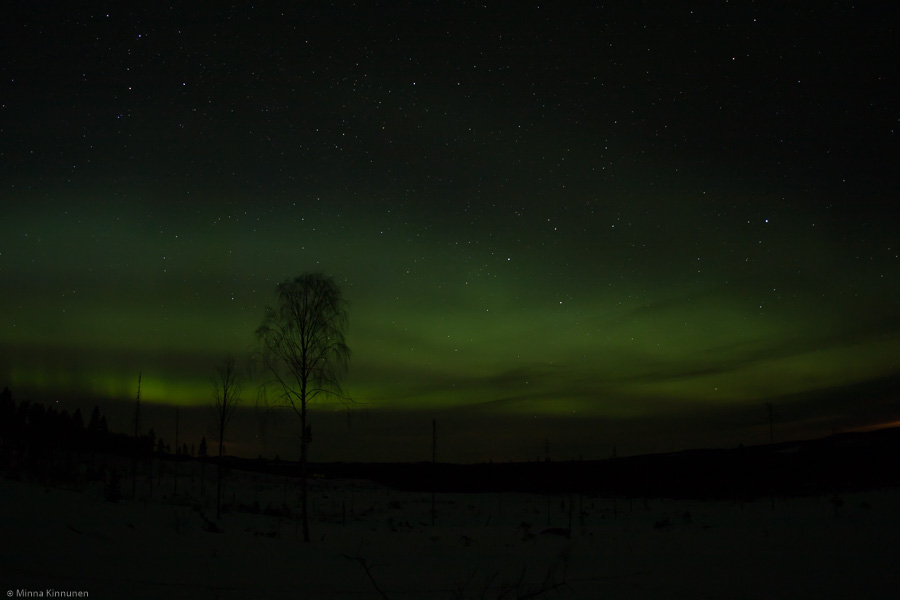
The sensor also caught some light pollution in the north (left of the birch in the above image), although I wasn’t able to see it. I reckon it must be Kårböle. To ENE, there was a visible glow of light (lower right edge in the image), maybe Ramsjö or even Ånge (100 km as the crow flies). And now that I’ve been staring the full res images, I can see that there is actually just the faintest of orange glows across almost the whole horizon below the green lights, and I’ve no idea where it comes from.
Now I’m just waiting for the next opportunity to see and shoot the auroras before the season is over!
Lämna ett svar